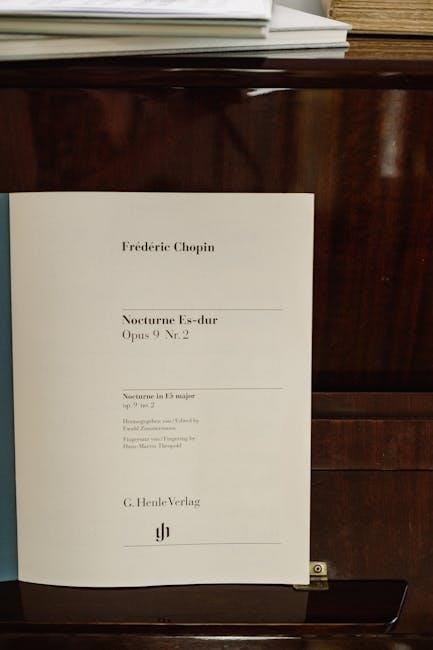
Chopin Nocturne in C-sharp Minor: A Comprehensive Guide
Discover readily available PDF sheet music for Chopin’s Nocturne in C-sharp Minor, Op. Posth., from sources like MuseScore, 8notes, and Musopen.
Explore Alfred Masterwork Editions for detailed publications, offering fingering and insightful musical guidance for pianists eager to learn this beautiful piece.
Historical Context of the Nocturne
Frédéric Chopin, a Polish composer and virtuoso pianist of the Romantic era, penned the Nocturne No. 20 in C-sharp minor, cataloged as B. 49 and published posthumously as Op. Posth. Unlike many of his nocturnes completed during his lifetime, this particular piece was discovered and prepared for publication after his death in 1849.
Composed around 1837, the nocturne reflects Chopin’s evolving compositional style, showcasing a deeper emotional intensity and harmonic complexity. While the exact circumstances surrounding its creation remain somewhat obscure, scholars believe it was likely intended as a private composition, perhaps for a close circle of friends and fellow musicians.
The availability of PDF versions today allows modern pianists to access and study this historically significant work with unprecedented ease. Digital archives and online music libraries, like those mentioned – MuseScore, 8notes, and Musopen – preserve and disseminate Chopin’s legacy, making his music accessible to a global audience. The Alfred Masterwork Edition provides a scholarly approach to the piece.
Chopin’s Nocturnes: An Overview
Chopin’s nocturnes, numbering 21 in total, represent a significant contribution to the Romantic piano repertoire. Characterized by their lyrical melodies, expressive harmonies, and delicate textures, they stand apart from earlier nocturnes, evolving into intensely personal and poetic musical statements. They are not simply “night pieces,” but rather explorations of mood and emotion.
These compositions often feature a singing melody line over a flowing, arpeggiated accompaniment, creating a sense of intimacy and introspection. Chopin masterfully utilizes rubato – a flexible tempo – to enhance the expressive quality of his nocturnes, allowing for subtle nuances and emotional depth.
Accessing these works today is simplified through readily available PDF sheet music. Platforms like MuseScore, 8notes, and Musopen offer digital scores, while publications like the Alfred Masterwork Edition provide scholarly editions. The C-sharp minor nocturne, though published posthumously, embodies the core characteristics of Chopin’s nocturne style, making it a beloved piece for pianists worldwide.
The Unique Character of Nocturne No. 20 in C-sharp Minor (Op. Posth.)
Nocturne No. 20 in C-sharp Minor, Op. Posth., stands as one of Chopin’s most emotionally resonant and technically demanding pieces. Unlike many of his nocturnes, this work possesses a dramatic intensity and a sense of underlying melancholy. Its posthumous publication suggests it was a deeply personal composition, perhaps not intended for immediate public performance.
The piece is notable for its expansive melodic range and complex harmonic language. The famous opening melody, imbued with a profound sense of longing, is supported by a rich and often turbulent left-hand accompaniment. Finding a reliable PDF version is crucial for accurate interpretation.
Resources like Musopen offer copyright-free access, while MuseScore and 8notes provide downloadable sheet music. Alfred Masterwork Editions offer detailed, scholarly versions. Mastering this nocturne requires careful attention to phrasing, dynamics, and pedaling, making a well-edited PDF invaluable for study.

Understanding the Sheet Music (PDF)
Accessing Chopin’s Nocturne in C-sharp Minor PDF scores is readily available online through platforms like MuseScore, 8notes, and Musopen for pianists.
Locating Reliable PDF Sources
Finding trustworthy sources for Chopin’s Nocturne in C-sharp Minor PDF sheet music requires careful consideration. Several online platforms offer free and paid options, each with varying degrees of accuracy and completeness. MuseScore.com is a popular choice, providing user-submitted arrangements alongside official publications, allowing downloads in both PDF and MIDI formats.
8notes.com also presents a free resource, though the quality can differ between arrangements. Musopen.org stands out by offering copyright-free scores, ensuring legal access to Chopin’s masterpiece. For a more scholarly and detailed edition, the Alfred Masterwork Edition, available through retailers like Amazon, provides meticulously edited scores with insightful fingerings and musical markings.
Always cross-reference multiple sources to ensure accuracy and identify any discrepancies. Prioritize editions from reputable publishers to guarantee a reliable and musically informed performance experience. Checking user reviews and comments can also provide valuable insights into the quality of specific PDF versions.
MuseScore as a Source for Chopin Nocturne PDFs
MuseScore.com serves as a vast repository for Chopin’s Nocturne in C-sharp Minor PDF sheet music, offering a diverse range of arrangements catering to various skill levels. Users can readily download and print scores in PDF or MIDI format, facilitating both practice and performance. The platform features multiple interpretations of the Nocturne, including arrangements by MartijnT and ClassicMan, uploaded on May 14th, 2024, and earlier dates.
However, it’s crucial to exercise discernment when utilizing MuseScore. As a user-generated content platform, the accuracy and quality of arrangements can vary significantly. While many submissions are meticulously transcribed, some may contain errors or inconsistencies.
Therefore, comparing different versions and cross-referencing with established editions is highly recommended. MuseScore’s accessibility and free availability make it an excellent starting point, but verifying the score’s fidelity remains the pianist’s responsibility for a polished performance.
8notes.com for Free Sheet Music
8notes.com provides free PDF sheet music for Frédéric Chopin’s Nocturne in C-sharp Minor (B.49), offering a convenient resource for pianists seeking accessible scores. The platform allows users to download, print, and play the music directly from their website, making it a popular choice for quick access to classical pieces.
However, like MuseScore, 8notes.com relies on user contributions and publicly available arrangements. While the site offers a readily available version of the Nocturne, it’s essential to acknowledge potential variations in accuracy and editorial markings compared to authoritative editions.
Therefore, pianists should approach the 8notes.com score as a supplementary resource and consider verifying its accuracy against established publications, such as the Alfred Masterwork Edition, to ensure a faithful and musically informed interpretation. The date of the available score is January 31st, 2023.
Musopen.org: Copyright-Free Access
Musopen.org distinguishes itself as a valuable resource for accessing Chopin’s Nocturne in C-sharp Minor (B. 49, Op. posth.) in PDF and MP3 formats, all offered completely free of charge and without copyright restrictions. This makes it an ideal platform for educators, students, and performers seeking legally accessible sheet music.
The platform’s commitment to public domain music ensures that users can download and utilize the score for practice, performance, or educational purposes without licensing concerns. Musopen’s collection includes a wealth of classical compositions, fostering a vibrant community dedicated to the preservation and dissemination of musical heritage.
However, while the score is copyright-free, it’s advisable to review the edition carefully, as the quality and editorial markings may vary. Musopen provides a convenient and legal avenue for obtaining the Nocturne’s sheet music, promoting accessibility to this beloved piece.
Alfred Masterwork Edition: A Detailed Publication
The Alfred Masterwork Edition of Chopin’s Nocturne in C-sharp Minor (Op. Posth.) presents a meticulously prepared and detailed publication for serious pianists. Available through retailers like Amazon, this edition, edited by Willard A. Palmer, offers a comprehensive approach to learning and performing the piece.
This edition typically includes detailed fingerings, insightful phrasing suggestions, and pedagogical notes designed to guide the performer towards a nuanced interpretation. It’s considered a valuable resource for students and teachers alike, providing a solid foundation for technical and musical understanding.
While not a free PDF source, the investment in the Alfred Masterwork Edition is often justified by the quality of the editing and the wealth of information it provides, surpassing many freely available online versions in terms of accuracy and musical insight.

Analyzing the Musical Structure
Explore the Nocturne’s key of C-sharp minor, its lyrical melodies, and harmonic progressions found within readily available PDF sheet music for detailed study.
Key Signature and Time Signature
Delving into Chopin’s Nocturne in C-sharp Minor (Op. Posth.), the key signature immediately establishes a somber and expressive tone; The piece is firmly rooted in C-sharp minor, indicated by seven sharps in the key signature – a characteristic that contributes to its melancholic character. Accessing a PDF version of the sheet music readily reveals this crucial detail, allowing pianists to quickly grasp the harmonic landscape.
Regarding the time signature, the Nocturne is written in 12/8 time. This compound meter creates a flowing, waltz-like feel, despite the piece not being a traditional waltz. The 12/8 time signature, clearly visible in any PDF score, encourages a gentle, lilting rhythm, enhancing the Nocturne’s lyrical quality. Understanding both the key and time signature is fundamental to accurately interpreting and performing this iconic composition, and readily available PDF resources facilitate this understanding.
Melodic Development and Themes
Chopin’s Nocturne in C-sharp Minor unfolds with a primary melodic theme of profound lyricism and emotional depth. Examining a PDF of the score reveals how this theme is initially presented simply, then undergoes subtle yet significant development throughout the piece. The melody, characterized by its graceful contours and expressive ornamentation, is often found in the right hand, soaring above the accompanying harmonies.
Further analysis of the PDF sheet music demonstrates how Chopin masterfully employs thematic variation. The main theme returns in altered forms, sometimes fragmented, sometimes embellished, creating a sense of both familiarity and renewal. Secondary melodic ideas emerge, providing contrast and enriching the overall texture. These interwoven themes, easily traceable within a PDF score, contribute to the Nocturne’s captivating narrative and enduring appeal, showcasing Chopin’s genius for melodic invention.
Harmonic Structure and Chord Progressions
The harmonic language of Chopin’s Nocturne in C-sharp Minor, clearly visible in a PDF score, is richly chromatic and emotionally evocative. The piece is rooted in C-sharp minor, but Chopin frequently employs borrowed chords and unexpected harmonic shifts, creating a sense of longing and melancholy. A detailed PDF reveals frequent use of diminished chords and altered dominants, adding color and tension to the harmonic landscape.
Analyzing the chord progressions within the PDF sheet music demonstrates Chopin’s masterful use of harmonic suspensions and resolutions. These create moments of exquisite beauty and dramatic intensity. The harmonic structure isn’t simply a backdrop for the melody; it’s an integral part of the Nocturne’s expressive power, contributing significantly to its overall emotional impact. The PDF allows for a close study of these nuances.
The Role of the Left Hand Accompaniment
Examining a PDF of Chopin’s Nocturne in C-sharp Minor reveals the crucial role of the left-hand accompaniment. It’s far more than just harmonic support; it’s a foundational element shaping the piece’s atmosphere. The left hand typically employs a flowing, arpeggiated pattern, creating a delicate and ethereal texture. This pattern, clearly visible in the PDF score, provides a constant, gentle pulse that underpins the expressive melody.
The left-hand part isn’t static. Chopin subtly varies the arpeggios and introduces harmonic nuances, responding to the melodic line and enhancing the emotional impact. A detailed PDF allows pianists to observe these subtle shifts and understand how the left hand interacts with the right. Mastering this accompaniment, as shown in the PDF, is essential for capturing the Nocturne’s characteristic mood.
Technical Aspects for Pianists
PDF scores reveal fingering suggestions, pedaling markings, and tempo indications (Lento con gran espressione) crucial for mastering Chopin’s Nocturne in C-sharp Minor.

Fingerings and Their Importance
Examining PDF sheet music reveals varied fingering suggestions for Chopin’s Nocturne in C-sharp Minor, highlighting their critical role in navigating the piece’s technical demands. Effective fingerings facilitate smooth legato phrasing, particularly in the melodic lines, and enable pianists to execute the rapid passages with clarity and precision.
Different editions, such as those from Alfred Masterwork, often provide detailed fingerings, while others, like those found on MuseScore, may require the pianist to determine their own. Choosing appropriate fingerings minimizes hand tension, optimizes hand position, and allows for greater expressive control. Consider the pianist’s hand size and technical proficiency when selecting or adapting fingerings. Carefully studying the score and experimenting with different options is essential for finding fingerings that best suit individual needs and enhance the musical interpretation of this nocturne.
Pedaling Techniques for Expressiveness
Analyzing PDF scores of Chopin’s Nocturne in C-sharp Minor reveals pedaling is crucial for achieving its characteristic ethereal sound. Subtle and nuanced pedaling creates a wash of sound, blending harmonies and enhancing the nocturne’s lyrical quality. However, over-pedaling can result in muddiness, obscuring the melodic lines and harmonic clarity.
Careful synchronization of pedal changes with harmonic shifts is essential. Generally, a clear pedal change should accompany each harmonic progression, preventing unwanted dissonance. Half-pedaling techniques, indicated subtly in some editions, allow for a more gradual release of the sustain, creating a delicate and nuanced effect. Experimentation with different pedaling approaches, guided by musical phrasing, is key to unlocking the nocturne’s expressive potential. Mastering pedaling elevates the performance beyond technical accuracy, imbuing it with emotional depth.
Tempo and Dynamics: Lento con gran espressione
Examining PDF sheet music for Chopin’s Nocturne in C-sharp Minor confirms the marking “Lento con gran espressione” – slowly and with great expression – is paramount. This indicates a deliberate, unhurried tempo, allowing each note to resonate and contribute to the overall emotional impact. Dynamic contrast is equally vital; the score calls for a wide range, from delicate pianissimo passages to more forceful, yet restrained, mezzo forte sections.
Avoid a mechanical approach to tempo and dynamics. Instead, interpret the markings with sensitivity, allowing the music to breathe and flow naturally. Subtle rubato – a flexible tempo – can enhance the expressiveness, but should be used judiciously. PDF scores often lack the nuance of a live performance, so actively listening to recordings while studying the score is beneficial. Ultimately, conveying Chopin’s intended emotion is key.
Challenges in Performing the Nocturne
Analyzing PDF versions of Chopin’s Nocturne in C-sharp Minor reveals several performance challenges. The piece demands exceptional control over voicing, balancing the lyrical melody with the delicate left-hand accompaniment. Maintaining a consistent, singing tone throughout requires significant technical proficiency. Furthermore, the extensive use of legato phrasing and subtle rubato necessitates a refined touch and a deep understanding of Chopin’s style.
Difficulties also arise from the emotional depth required. Conveying the nocturne’s melancholic beauty and underlying passion demands more than just technical accuracy. Pianists must connect with the music on an emotional level, allowing their interpretation to shine through. Studying different PDF editions can highlight variations in fingering and phrasing, but ultimately, overcoming these challenges requires dedicated practice and artistic sensitivity.
Practice Strategies and Tips
Utilize PDF sheet music to isolate difficult passages, practice slowly with metronome, and develop emotional connection for a nuanced interpretation of Chopin’s work.
Breaking Down Difficult Passages
Successfully navigating Chopin’s Nocturne in C-sharp Minor requires a methodical approach to challenging sections. Begin by downloading a clear PDF version of the sheet music – resources like MuseScore and 8notes offer readily available options. Identify specific bars or phrases that present technical hurdles, such as rapid arpeggios or complex chord voicings.
Isolate these passages and practice them separately, at a significantly slower tempo than the overall piece. Focus on accuracy and evenness of touch, ensuring each note is clearly articulated. Utilize fingerings indicated in reputable editions, like the Alfred Masterwork Edition, or experiment to find what feels most comfortable and efficient for your hand.
Consider practicing hands separately to solidify each part before combining them. Once comfortable at a slow tempo, gradually increase the speed, maintaining precision and control. Repeat these isolated sections multiple times until they become ingrained in your muscle memory, allowing for a smoother and more confident performance within the context of the entire nocturne.
Developing Emotional Connection to the Piece
Beyond technical proficiency, conveying the emotional depth of Chopin’s Nocturne in C-sharp Minor is paramount. Begin by studying a reliable PDF score, allowing you to intimately understand the nuances of Chopin’s notation. Research the historical context and Chopin’s life during its composition – understanding his emotional state can inform your interpretation.
Listen to multiple recordings by renowned pianists, not to imitate, but to absorb different perspectives on phrasing and dynamics. Visualize the emotions Chopin intended to evoke – melancholy, longing, and a sense of quiet desperation.
Experiment with subtle variations in tempo and dynamics, allowing your emotions to guide your performance. Don’t be afraid to personalize your interpretation, but always remain respectful of the composer’s intent. Let the music breathe, and allow the beauty of the melody to resonate with your own emotional experiences, creating a truly captivating performance.
Resources for Learning and Improvement
Numerous online resources support mastering Chopin’s Nocturne in C-sharp Minor. Begin with PDF sheet music from platforms like MuseScore, 8notes, and Musopen, offering free and legal access to scores. Supplement this with the Alfred Masterwork Edition for detailed fingering suggestions and editorial insights.
YouTube tutorials provide visual guidance on technique and interpretation. Explore piano learning apps offering interactive lessons and feedback. Websites dedicated to classical music analysis offer in-depth harmonic and melodic breakdowns of the piece.
Consider working with a qualified piano teacher for personalized instruction. Online forums and communities connect pianists, fostering collaborative learning and sharing of resources. Utilize practice tracking apps to monitor progress and identify areas needing improvement, ensuring a well-rounded learning experience.
Interpreting Chopin’s Intentions
Understanding Chopin’s intent requires delving beyond the PDF sheet music. The “Lento con gran espressione” marking signifies a slow tempo with great expression – prioritize emotional depth over technical perfection. Chopin’s nocturnes aimed for a vocal quality; imagine a beautiful melody sung with nuanced phrasing.
Consider the historical context; Chopin wrote during the Romantic era, emphasizing emotion and individualism. Explore analyses of his harmonic language, particularly his use of chromaticism and subtle shifts in tonality. The nocturne’s melancholic character suggests a longing or introspection.
Study recordings by renowned Chopin interpreters, noting their dynamic range, pedaling, and rubato. However, avoid mere imitation; strive to develop your own unique interpretation informed by your understanding of Chopin’s style and emotional world.

Variations and Arrangements
Discover diverse PDF editions, arrangements for other instruments, and the nocturne’s presence in popular culture, showcasing its enduring appeal and adaptability for musicians.
Different Editions and Their Differences
Exploring the landscape of Chopin’s Nocturne in C-sharp Minor PDFs reveals a fascinating array of editions, each presenting subtle yet significant differences for the pianist. The Alfred Masterwork Edition, frequently cited, provides detailed scholarly insights and careful editing, often including nuanced fingerings proposed by Willard A. Palmer.
Conversely, free PDFs sourced from platforms like MuseScore and 8notes.com, while accessible, may exhibit variations in engraving style, fingering suggestions (or lack thereof), and even minor discrepancies in the notes themselves due to transcription processes. These variations aren’t necessarily errors, but reflect different interpretations and editorial choices.
Furthermore, comparing editions highlights differences in dynamic markings and phrasing suggestions, impacting the overall expressive character of the piece. Pianists should critically evaluate multiple sources, cross-referencing them to form their own informed interpretation and selecting an edition that aligns with their artistic vision and technical capabilities. The availability of these diverse PDF options empowers musicians to engage deeply with Chopin’s masterpiece.
Arrangements for Other Instruments
Beyond its iconic status as a piano piece, Chopin’s Nocturne in C-sharp Minor has inspired numerous arrangements for diverse instruments, readily available as PDF transcriptions. These adaptations extend the nocturne’s reach, allowing musicians beyond the piano world to explore its melodic beauty and harmonic richness.
Common arrangements include versions for solo cello, violin, and guitar, often simplifying the complex piano textures while preserving the essential emotional core. Orchestral arrangements also exist, expanding the nocturne’s sonic palette with lush string harmonies and delicate woodwind countermelodies.
Searching online repositories reveals PDF scores tailored for ensembles, such as flute and piano or clarinet and piano, facilitating chamber music performances. While these arrangements inevitably deviate from Chopin’s original intent, they demonstrate the enduring appeal and adaptability of his composition. Accessing these PDFs broadens the nocturne’s accessibility and fosters creative interpretations across instrumental boundaries.
The Nocturne in Popular Culture
Chopin’s Nocturne in C-sharp Minor has transcended the concert hall, permeating popular culture and appearing in numerous films, television shows, and commercials. Its melancholic beauty and instantly recognizable melody make it a frequent choice for scenes evoking romance, loss, or introspection. Finding PDF sheet music allows aspiring musicians to connect with this cultural phenomenon.
Notably, the nocturne gained renewed prominence through its inclusion in the 1993 film The Piano, contributing significantly to the movie’s emotional impact. It’s also been featured in various video games and television dramas, solidifying its place in the collective consciousness.
The widespread availability of PDF transcriptions has further fueled its popularity, enabling amateur pianists to learn and perform this iconic piece. This accessibility ensures Chopin’s masterpiece continues to resonate with audiences across generations, demonstrating its enduring power and cultural significance.